If you’ve walked into an auto dealership service bay lately, you’ve noticed the change: fewer junk drawers and technicians who can actually find the 10 mm socket. The catalyst is 5S—a lean framework (Sort, Set in order, Shine, Standardize, Sustain) that has long proven itself in manufacturing and is now rapidly adopted by retail auto groups seeking higher bay throughput, tighter warranty compliance, and better CSI scores.
From chaos to control.
Dealership service departments are complex micro-factories. Every minute a vehicle sits on a lift waiting for tools, approvals, or parts is a margin left on the floor. 5S attacks that waste at its source. By sorting tools to eliminate duplicates and damage, then setting them in precise, visible homes, technicians shave seconds off dozens of micro-motions per job. Shine and standardize, keep those gains from eroding; sustain them by locking them in with simple audits and visual controls. The result is a repeatable cadence: tools where they belong, processes that stick, and leaders who can spot problems at a glance.
Where 5S meets the toolbox.
The tipping point for dealers isn’t philosophy—it’s fixtures. You can’t “standardize” on a messy drawer. That’s why many service directors pair 5S with tooling systems purpose-built for productivity. Sonic has become a go-to in this shift because its ecosystem is engineered for visual control and repeatability, the heart of any 5S operation.
Foam-first tool control.
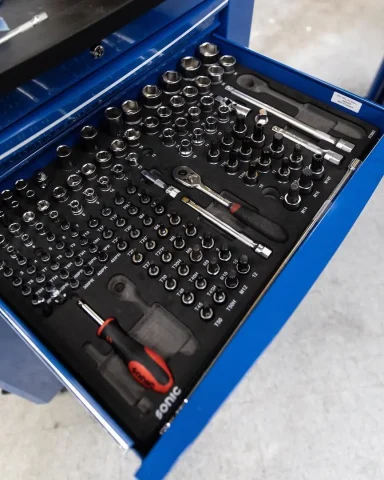
Sonic’s laser-etched, color-contrasting EVA foam inlays create instant, high-visibility tool control: every wrench, bit, and driver has a dedicated, labeled pocket. Missing tools are identified in literally seconds, preventing job slowdowns and reducing the risk of FOD in customer vehicles. For multi-roof groups, Sonic’s custom foam capability enables standardized layouts by role (e.g., quick-service, line tech, transmission) so technicians can move between stores without a learning curve. It’s 5S “Set in order” turned into hardware.
Storage that enforces standards.
The NEXT series toolboxes and MSS+ modular cabinets extend that visual discipline beyond a single drawer. Full-extension slides, sealed ratchet heads stored in dedicated cavities, and modular cabinet runs allow bays to be mirrored across the shop—critical for dealers managing staggered shifts and shared equipment. With Sonic, layout isn’t an afterthought; it’s a productivity asset. The company’s cabinet system integrates power management and work surfaces, reducing walk time to benches and chargers and helping shops keep “Shine” achievable with wipe-clean materials.
Operational benefits dealers care about.
Lean isn’t just neat; it’s financial. Faster tool retrieval and fewer lost items translate into higher flag hours per tech and tighter variance between quoted and actual time. Visual drawers speed onboarding for new hires and temps—particularly valuable amid persistent tech shortages. Consistent kits and documented layouts support warranty audit readiness. Sonic’s lifetime warranty reduces administrative friction, and its U.S. inventory depth—more than 6,000 SKUs—helps managers sustain standards with like-for-like replacements, not a patchwork of brands that erode 5S discipline.
Make 5S stick.
The hardest part of 5S is the fifth S—Sustain. Sonic simplifies it with audit-friendly visuals: an open drawer reads like a checklist. Many dealers schedule five-minute end-of-shift resets and monthly bay audits; with Sonic’s foam, those routines are fast, objective, and coachable. Tie that to KPI dashboards—cycle time, comeback rate, bay utilization—and 5S becomes a performance system, not a poster on the wall.
For auto dealerships, the path to more billable hours and higher CSI isn’t just about new lifts or bigger waiting rooms—it’s about disciplined, visible, standardized tool control. 5S provides the blueprint. Sonic provides the hardware that makes it an easy-to-implement reality.