In aviation maintenance, productivity isn’t about rushing—it’s about removing friction so technicians can do precise work faster, safer, and with fewer interruptions. Every minute an AOG aircraft sits idle is expensive. Every misplaced tool becomes a potential FOD event. Every re-opened panel, missing sign-off, or repeated trip back to the tool room quietly stacks delay on top of delay.
The fastest MROs and flight departments don’t rely on heroics. They build systems that make the right work easier to execute every time. And the most overlooked lever in that system is also the most basic: tool control.
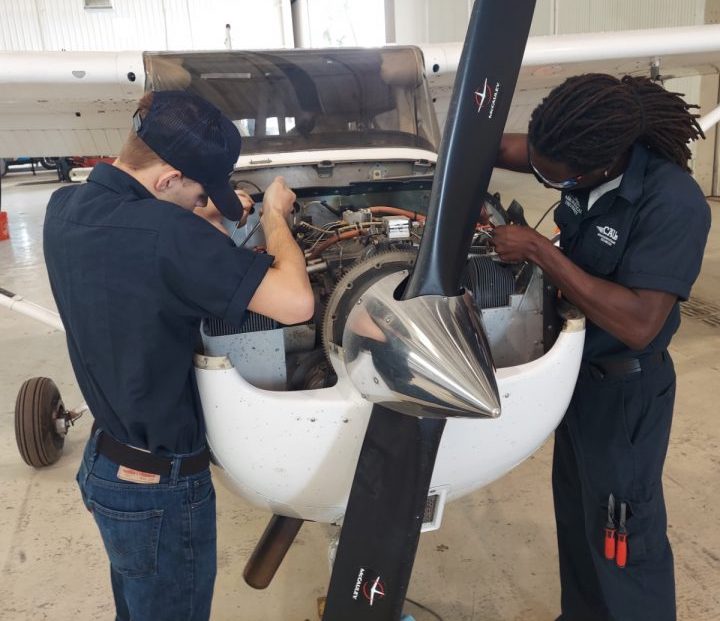
The real productivity killers in aviation maintenance
Ask any experienced technician what slows work down and you’ll hear the same themes:
- Searching for tools (or discovering they’re missing mid-task)
- Walking (to the crib, to another bay, to borrow a specialty tool)
- Setup and teardown time between jobs
- Rework caused by inconsistencies, miscommunication, or incomplete kits
- Audit and compliance pressure that steals time when documentation isn’t tight
- FOD risk and “tool last seen” investigations that shut down progress fast
None of these issues reflect a lack of skill. They reflect a lack of organization and standardization—and standardization is how you scale productivity without compromising quality.
The productivity formula: standard work + visual control + zero tool drama
High-performing aviation maintenance environments run like this:
- Standardized toolsets per aircraft type, job family, or station
- Visual control so anyone can see what’s missing instantly
- Kitted workflows so jobs start with everything required
- Accountability built into the system, not dependent on memory
- Repeatable layout so techs don’t “re-learn the room” every shift
That’s the bridge between “busy” and truly productive.
Sonic’s tool control changes the game
If you want one move that improves productivity across speed, safety, and consistency, it’s this: give every technician a complete, standardized, tool-controlled workstation—and keep it that way.
That’s exactly what Sonic is designed to do. Bring control from the chaos.
1) Cut search time to near-zero
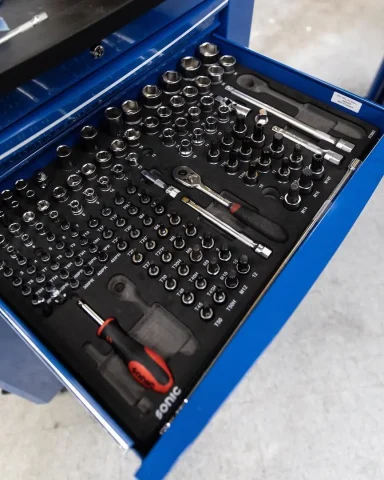
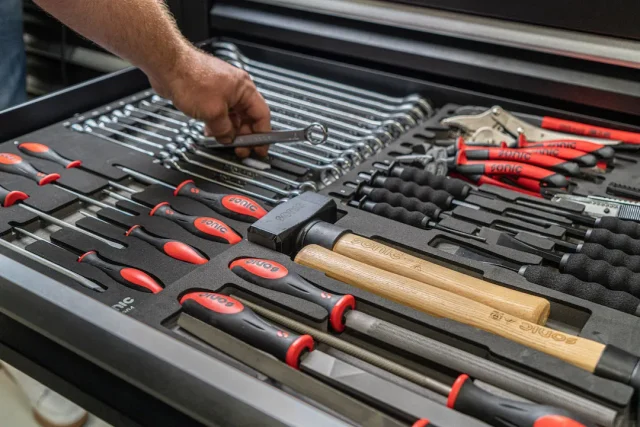
Sonic’s foam inlays create immediate visual management: every tool has a dedicated home, and missing tools are obvious at a glance. When tools can’t “disappear,” you eliminate the constant stop-and-search cycle that quietly drains hours per week per technician.
2) Reduce rework and prevent “job stalls”
When a job pauses because a tool is missing, productivity collapses. Sonic’s complete toolsets and consistent layouts reduce those mid-task interruptions. Technicians start jobs confident they have what they need—and that confidence shows up as smoother, faster task execution.
3) Strengthen FOD prevention without adding overhead
FOD prevention is non-negotiable—and it often creates hidden administrative time when tool control isn’t tight. Sonic’s visual tool control supports a cleaner “tool in/tool out” reality without adding complexity. Fewer investigations. Faster closeouts. Less anxiety at shift change.
4) Standardize across teams, shifts, and locations
Aviation maintenance operations struggle when everything is personalized. Sonic enables standardization at scale: same drawers, same layouts, same tool homes. That means faster onboarding, easier cross-coverage between shifts, and less tribal knowledge required to operate efficiently.
5) Improve workstation flow and ergonomics
Productivity is also physical. A well-designed toolbox and drawer system reduces bending, reaching, and wasted motion. The result is faster work with less fatigue—especially on long shifts or heavy-check environments.
A practical starting point
If you’re serious about increasing productivity, start with a pilot:
- Pick one bay or one crew
- Standardize their most-used toolset (the “80% tools for 80% jobs”)
- Implement foam inlays and drawer labeling
- Track before/after on: time-to-start, job interruptions, missing tool incidents, and rework hours
The results show up quickly—and they scale.
In aviation maintenance, productivity is earned through repeatability, not speed. Sonic helps deliver that repeatability by removing one of the biggest sources of daily drag: uncontrolled tools. When your tools are standardized, visible, complete, and accountable, technicians spend less time hunting—and more time turning aircraft safely back into the sky.